
What Are Patent Drawings?
Patent drawings are technical illustrations submitted with a patent application to visually explain an invention’s structure, components, configuration, or operation. They work alongside the written specification to help readers understand the subject matter for which patent protection is requested.
Depending on the invention, drawings may show an entire product, individual components, internal mechanisms, electrical connections, manufacturing arrangements, or process steps. They can include line illustrations, sectional views, diagrams, flowcharts, and other technical representations.
Patent drawings are not simply decorative images or product sketches. They form part of the technical disclosure and must accurately represent the invention described in the application.
Under U.S. patent law, an applicant must provide drawings when they are necessary to understand the subject matter being patented. Even when not strictly necessary, drawings may be useful in explaining an invention.
Why Are Patent Drawings Important?
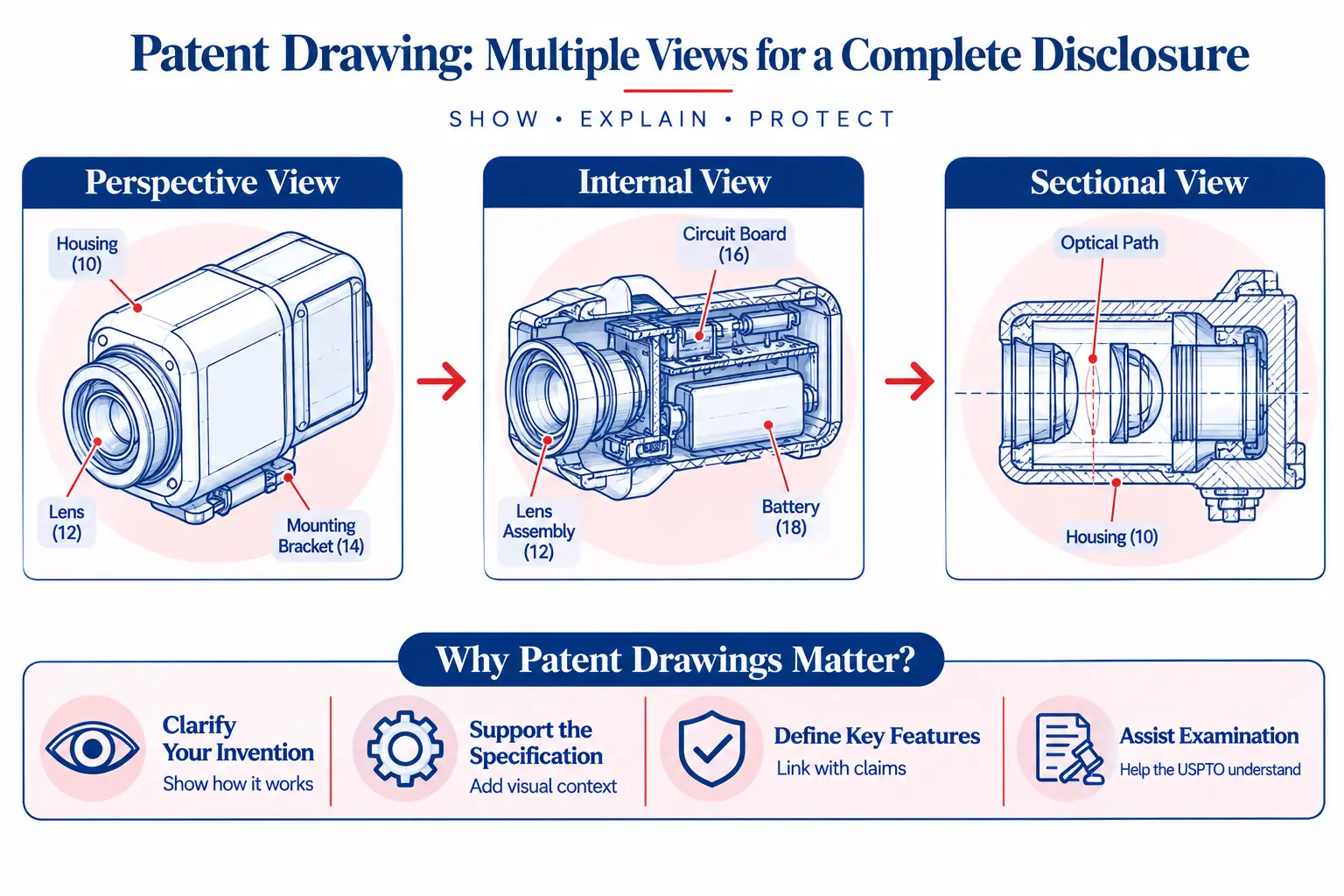
Patent drawings help communicate technical information that may be difficult to explain through words alone. They allow an examiner to understand the arrangement of components, the relationship between parts, and the features described in the claims.
Their importance extends to several parts of the patent process:
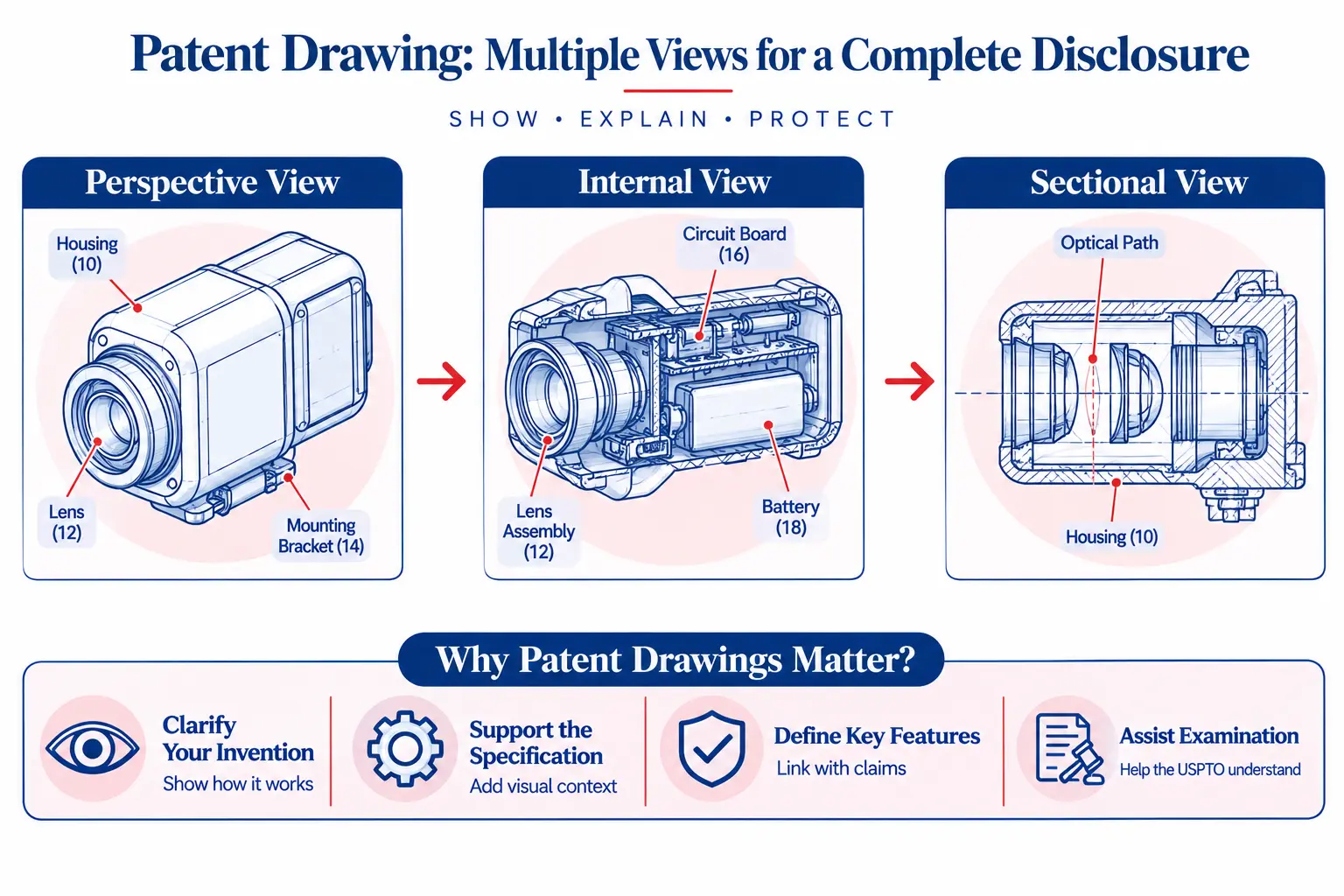
- Clarifying the invention: Illustrations show the physical arrangement, construction, and relevant features of an invention.
- Supporting the specification: Figures provide visual context for the written description and help readers interpret technical details.
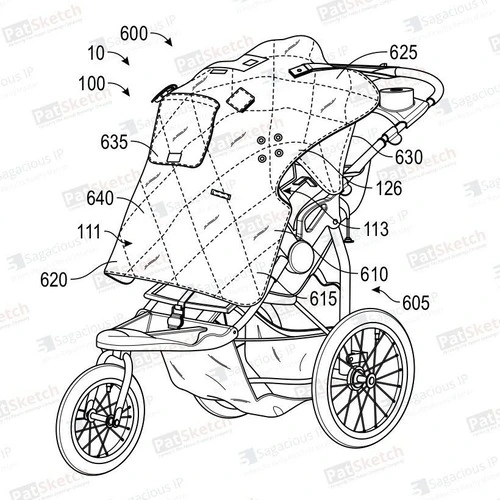
- Identifying components: Reference numerals connect specific parts in the drawings with their explanations in the specification.
- Showing claimed features: Drawings help illustrate the features identified in the claims, where those features are capable of visual representation.
- Supporting examination: Clear figures make it easier for the examiner to understand the disclosed subject matter.
The USPTO requires drawings to show the features of the invention specified in the claims, subject to the rules for conventional features and other permitted representations.
Common Types of Patent Drawings
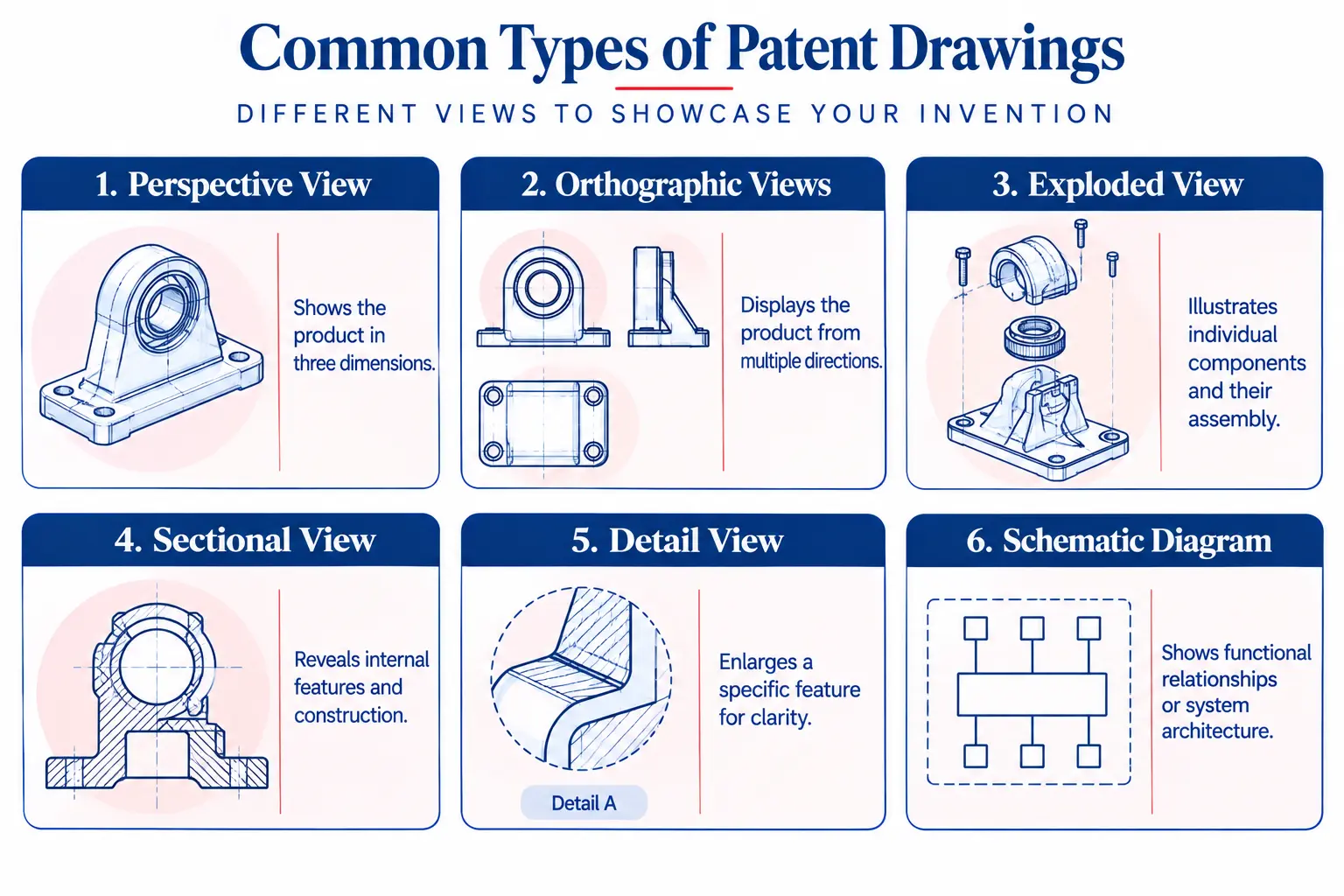
The type and number of drawings depend on the invention and the information that needs to be communicated. A patent application may contain several views to explain different aspects of the same subject matter.
- Perspective Views
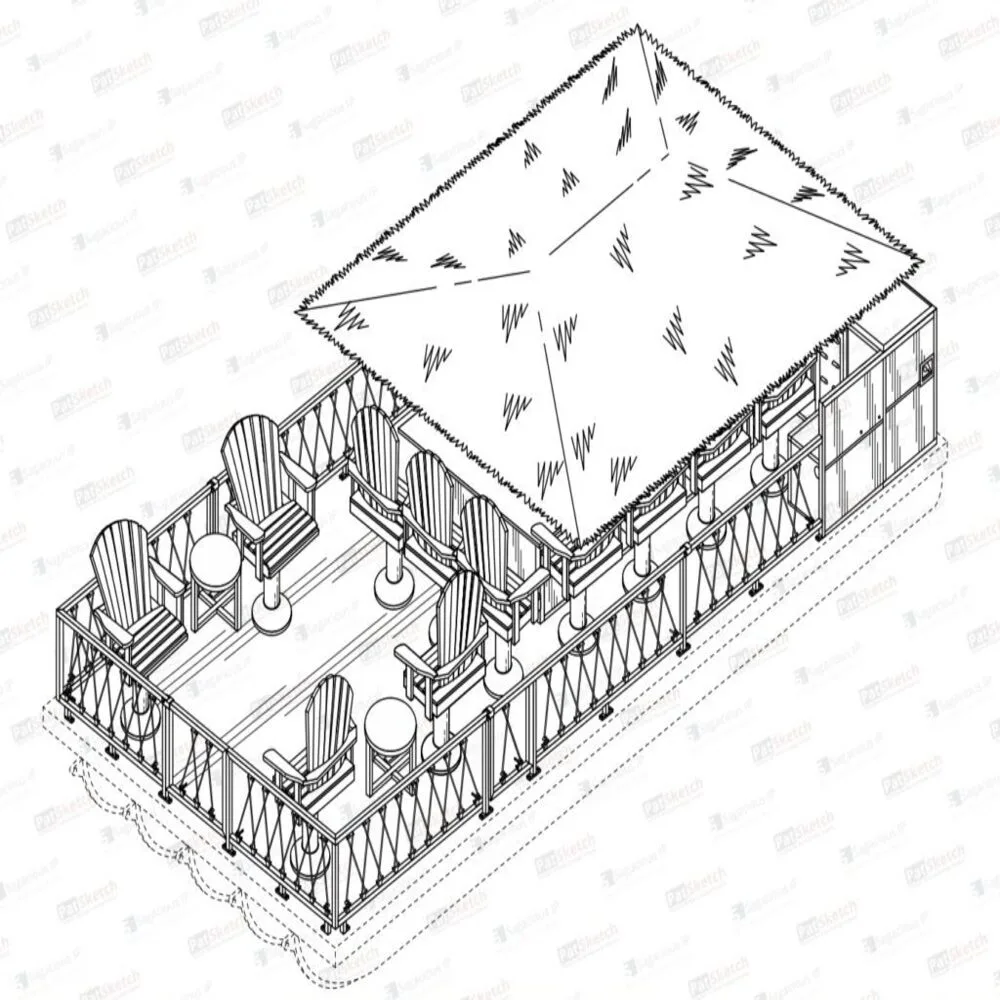
A perspective view presents an object in three dimensions, showing multiple sides in one illustration. It is useful for communicating the overall shape, configuration, and spatial relationship of visible features. - Front, Side, Rear, and Top Views
These orthographic views show an object from specific directions. They are particularly useful when the dimensions, proportions, and external features need to be represented consistently across multiple illustrations. - Exploded Views
An exploded view separates components visually while maintaining their relative arrangement. It helps explain how individual parts fit together and how an assembly is structured. - Sectional Views
A sectional view reveals internal features by showing an object as if it has been cut along a specified plane. It can illustrate hidden components, internal passages, material arrangements, and mechanical relationships. - Detail Views
Detail views enlarge a particular portion of an invention to show features that may be difficult to distinguish in the main illustration. They are useful for small components, connections, surface features, and intricate mechanisms. - Flowcharts and Schematic Diagrams
Flowcharts represent the sequence of operations in a process or method, while schematic diagrams illustrate functional relationships between system components. They are commonly useful for software-related inventions, electronic systems, and technical processes.
USPTO Patent Drawing Requirements Under 37 CFR 1.84
Patent drawings submitted to the United States Patent and Trademark Office (USPTO) must follow the applicable formal requirements. 37 CFR 1.84 establishes standards covering drawing presentation, sheet dimensions, margins, views, lines, lettering, shading, and related details.
Sheet Size and Margins
Drawing sheets must use one of the permitted formats: 21.0 × 29.7 cm (A4) or 21.6 × 27.9 cm (8.5 × 11 inches). The regulation also specifies minimum margins:
| Margin | Minimum requirement |
| Top | 2.5 cm (1 inch) |
| Left | 2.5 cm (1 inch) |
| Right | 1.5 cm (5/8 inch) |
| Bottom | 1.0 cm (3/8 inch) |
All drawing sheets in an application must be the same size. The usable drawing area must remain within the prescribed margins.
Line Quality and Reproduction
Patent drawings must have clear, dark, and sufficiently dense lines that reproduce well. Line thickness should be consistent and suitable for reproduction. Numbers, letters, and reference characters must also remain legible.
The scale must allow the mechanism to be understood when the drawing is reduced during reproduction. Details should not become crowded or indistinguishable.
Views and Figure Arrangement
An application should contain as many views as necessary to show the invention. These may include plan, elevation, sectional, perspective, and enlarged detail views.
Figures should be arranged clearly, with adequate separation and no unnecessary overlap. Where a sectional view is used, the cutting plane and direction of sight should be indicated appropriately in the related view.
Black-and-White and Color Drawings
Black-and-white drawings are normally required for utility patent applications. Color drawings are permitted in design applications under specified conditions, while color may be accepted in utility applications only in limited circumstances when it is the only practical way to disclose the subject matter.
The required formalities for submitting color drawings must also be followed.
How to Prepare Drawings for a Patent Application
Preparing drawings for patents requires a structured approach. The illustrations must communicate the invention accurately and remain consistent with the written disclosure.
Step 1: Understand the Invention
Review the invention’s technical description, components, functions, and claimed features. Identify which parts need visual explanation and whether internal or external details are relevant.
Step 2: Select the Required Views
Determine which views will communicate the invention most effectively. A mechanical assembly may require exploded and sectional views, while a product with distinctive external features may need multiple orthographic and perspective views.
Step 3: Create Accurate Technical Illustrations
Prepare the figures using appropriate technical drawing methods. Maintain accurate proportions, component relationships, and visible details. Avoid adding features that are not supported by the invention disclosure.
Step 4: Add Reference Numerals
Assign reference numerals consistently to relevant components. Use the same numeral for the same component across different figures, and ensure that each numeral corresponds to the terminology used in the written description.
Step 5: Review the Complete Drawing Set
Check the figures for missing views, unclear lines, inconsistent numbering, and discrepancies with the specification. Confirm that the drawing sheets satisfy the applicable USPTO formatting requirements before submission.
Best Practices for High-Quality Patent Illustrations
Formal compliance is essential, but well-prepared patent illustrations also require careful technical judgment. The following practices help improve clarity and consistency:
- Maintain visual consistency: Use consistent proportions, orientations, and reference numerals across related figures.
- Prioritize clarity: Make sure important components and connections are easy to distinguish.
- Avoid unnecessary detail: Include information that helps explain the invention without overcrowding the illustration.
- Coordinate drawings with the specification: Use matching terminology and ensure every illustrated feature is supported by the written disclosure.
- Choose views strategically: Include different angles or enlarged sections when they communicate information that a single view cannot show.
- Review at reduced size: Check that important lines, labels, and component details remain legible when reproduced.
These are preparation recommendations rather than separate legal requirements. The appropriate drawing set will depend on the invention and the subject matter being disclosed.
Why Work With a Professional Patent Drawing Service?
Patent illustrations require more than general drafting or graphic design skills. A patent drawing specialist must understand technical representation, figure consistency, reference numerals, and the formal requirements applicable to patent applications.
Professional preparation can be particularly valuable for inventions involving complex mechanical assemblies, electronic devices, interconnected components, or intricate product configurations. A specialist can help translate technical information into clear figures while coordinating the illustrations with the inventor’s disclosure and the patent professional’s instructions.
At PatSketch, patent drawing services support inventors, patent attorneys, and businesses with technical illustrations prepared for patent application requirements. The objective is to make complex inventions easier to understand through accurate, clear, and professionally presented drawings.
Frequently Asked Questions (FAQs)
-
Are patent drawings mandatory for every patent application?
No. Drawings are required when necessary to understand the subject matter being patented, and an examiner may require them in certain circumstances. Even when not mandatory, drawings can help explain technical features and support the application disclosure.
-
What should patent drawings include?
Patent drawings should show the relevant features of the invention, including its structure, components, configuration, or operation where applicable. The required views depend on the invention and the subject matter described in the claims.
-
Can I use hand-drawn sketches for a patent application?
Hand-drawn sketches can help document an invention during its development, but informal sketches should not automatically be treated as filing-ready patent drawings. Submitted drawings must satisfy the applicable USPTO standards for clarity, presentation, and reproduction.
-
How many drawings are required for a patent application?
There is no fixed number of figures required for every application. The drawing set should contain enough views to explain the invention clearly and show the relevant claimed features.